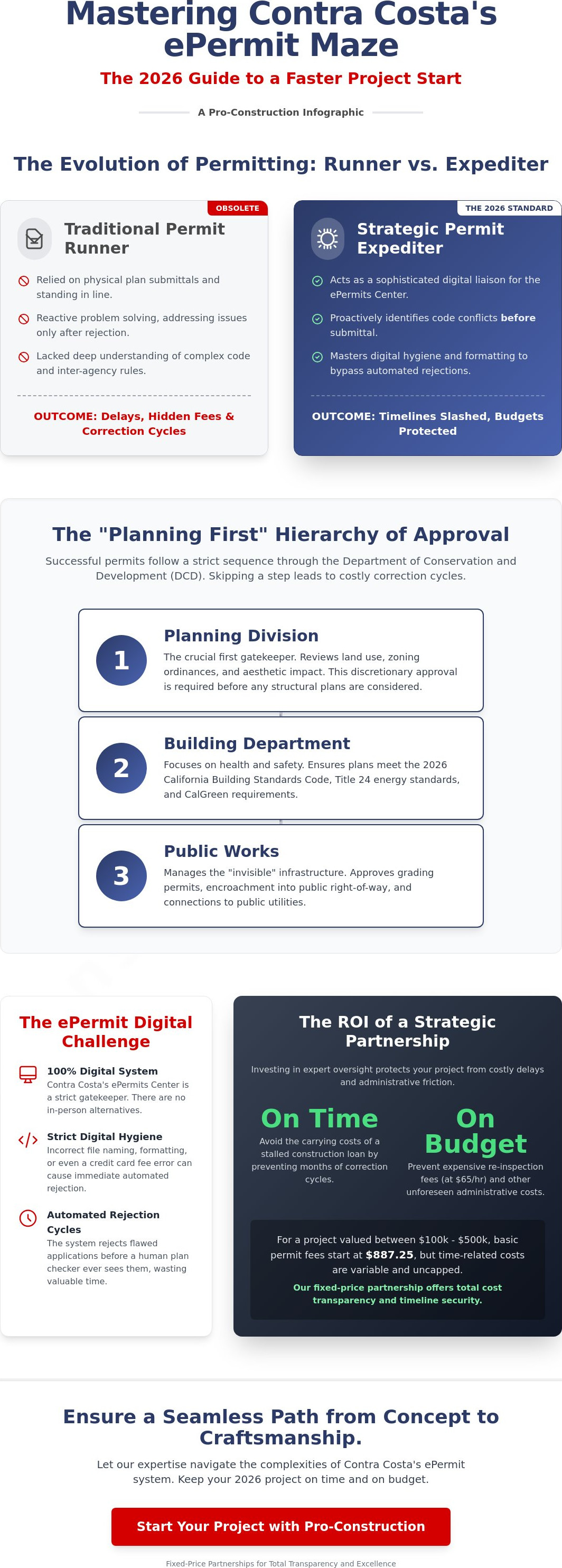
In 2026, the traditional permit runner is officially obsolete. Since Contra Costa County transitioned to a 100% digital ePermit system, the secret to a fast project start is no longer about who can stand in line the longest, but who understands the code before the first pixel is uploaded. Choosing a strategic permit expediter Contra Costa County developers trust means moving beyond simple submittals and into the realm of integrated compliance.
We understand that the current digital-only landscape feels like a maze of inter-agency miscommunication and hidden correction cycles. It's frustrating to watch a bespoke vision stall because of a 2.75% credit card fee error or a minor plan check discrepancy. We believe your investment deserves a seamless path from concept to craftsmanship. This guide provides a clear roadmap to master the ePermit Center, avoid the delays of the 2026 fee schedule updates, and reduce the stress of local code enforcement. You'll learn how a disciplined partnership can slash months off your timeline and ensure your project begins with total transparency and excellence.
Key Takeaways
- Understand the shift to a 100% digital ePermits Center and why modern technical expertise has replaced traditional counter visits.
- Navigate the "Planning First" hierarchy to ensure your project coordinates seamlessly between the Planning, Building, and Public Works departments.
- Discover why a strategic permit expediter Contra Costa County is the key to identifying code conflicts before they trigger months of correction cycles.
- Master the strict digital hygiene and formatting conventions required by the Department of Conservation and Development to prevent immediate submittal rejections.
- Learn how a fixed-price partnership provides the transparency and professional oversight needed to keep your 2026 construction timeline on-budget.
What is a Permit Expediter and Why Does Contra Costa County Require One in 2026?
The modern permit expediter serves as a sophisticated digital liaison between your project vision and the Contra Costa County Department of Conservation and Development (DCD). In 2026, this role has evolved far beyond the traditional "permit runner" who physically delivered blueprints to a county clerk. Today, the process of obtaining planning permission is an entirely electronic endeavor. We act as your bureaucracy translator, ensuring that every digital submittal aligns with the county's rigorous expectations for transparency and technical accuracy. Without professional oversight, even a minor interior remodel can trigger hidden correction cycles that stall progress for months.
Contra Costa County enforces specific local ordinances, including Title 24 energy standards and CalGreen requirements, that demand a high level of technical precision. A permit expediter Contra Costa County specialist understands that the county now prioritizes all-electric construction designs as part of its climate action initiatives. We manage these complexities on your behalf, transforming a fragmented administrative hurdle into a structured, manageable phase of your construction journey.
The Evolution of Permitting in Contra Costa
The transition to a 100% digital ePermits Center portal has fundamentally changed how projects start. While the county designed this system for efficiency, it increased the technical burden on homeowners. The ePermit Center now functions as a strict gatekeeper. If your digital files don't meet specific naming conventions or formatting standards, the system rejects the application before a plan checker ever reviews it. We maintain rigorous digital hygiene to bypass these automated rejections. In the high-stakes Bay Area market, where housing permits saw a significant rise following the 2021 surge, any delay in the submittal queue represents a missed opportunity to break ground.
The ROI of Strategic Expediting
We view permitting as a disciplined investment in your project's timeline. The financial return of hiring a strategic partner is clear when you calculate the carrying costs of a stalled construction loan. For a project with a valuation between $100,001 and $500,000, the building permit fee starts at $887.25 plus $5.00 for each additional $1,000. These costs are fixed, but the time spent in review is not. We identify "red flag" code issues during the design phase, preventing the re-inspection fees that currently cost $65.00 per hour. Our partnership model focuses on a "no-surprises" philosophy. By providing end-to-end solutions, we ensure your project remains on-time and on-budget, protecting your investment from the friction of administrative miscommunication.
The Hierarchy of Approval: Planning, Building, and Public Works
Successful permitting in Contra Costa County requires a disciplined understanding of the local "order of operations." We view the Department of Conservation and Development (DCD) not as a single entity, but as a three-layered hierarchy. Each layer has its own set of standards and specific gatekeepers. To ensure a seamless project start, you must navigate these departments in a precise sequence. Attempting to bypass one stage to reach the next often results in the "correction cycles" that stall construction for months. We act as the steward of your investment by masterfully managing these inter-departmental handoffs.
The "Planning First" rule is the foundation of this hierarchy. In unincorporated areas and contract cities like Lafayette or Orinda, the Planning Division must approve the land use and aesthetic impact of your project before any structural review begins. This discretionary phase determines if your vision aligns with local zoning ordinances. Once Planning issues their approval, the Building Department takes the lead. Their focus shifts to health, safety, and structural integrity, ensuring your plans meet the 2026 California Building Standards Code. Finally, the Public Works Department manages the "invisible" infrastructure, such as grading permits and encroachment into the public right-of-way. A permit expediter Contra Costa County specialist ensures these three departments remain in sync, preventing the miscommunication that leads to budget overruns.
Planning Applications vs. Building Permits
Many homeowners assume a Building Permit is the first step, but complex projects often require a Planning Variance first. This is especially true for custom homes or significant footprint expansions. If you are researching ADU contractors, you should know that Accessory Dwelling Units in Contra Costa now follow a streamlined ministerial review, yet they still require a "Planning-level" check for setbacks and height limits. Major custom builds may even trigger a Public Hearing phase, where we represent your interests to ensure a favorable outcome.
The Role of Special Districts
External agencies often act as the "silent killers" of a construction timeline. Even with county approval, your project cannot move forward without sign-offs from special districts. We coordinate directly with these entities to maintain momentum:
- ConFire (Contra Costa County Fire Protection District): Reviews for fire flow, hydrant proximity, and emergency access.
- Sanitary Districts: Verify sewer capacity and connection fees for new fixtures.
- Environmental Health: Required for projects involving septic systems or well water.
- Water Districts: Ensure compliance with the latest drought-resistant landscaping mandates.
The "Master Permit" in Contra Costa County is a comprehensive authorization that consolidates these various approvals into a single, cohesive document for large-scale renovations. If you want to ensure your project stays on-track, we invite you to consult with our team to see how we manage these complex sequences.
Permit Runner vs. Strategic Expediter: Choosing Your Solution
Identifying the right permit expediter Contra Costa County requires a clear understanding of your project’s technical complexity. Many homeowners mistakenly hire a "runner" when their project actually demands a strategic consultant. A runner primarily provides administrative support, moving documents through a system without analyzing their content. In the digital-only environment of 2026, this model often fails. When a plan checker asks a technical question about structural loads or Title 24 compliance, a runner lacks the expertise to provide an immediate solution. This leads to information loss and unnecessary delays that can derail a construction timeline.
Administrative runners are suitable for minor, prescriptive projects. If you're swapping a water heater or upgrading an electrical panel, the requirements are straightforward. However, for complex structural renovations, a runner becomes a liability. They didn't draw the plans, so they can't defend the design choices to a county official. This disconnect causes friction. We've seen projects stall for 45 days simply because a runner couldn't explain a specific grading detail on a digital submittal. In a 100% digital landscape, you need a partner who speaks the language of the code, not just someone who knows how to upload a PDF.
Evaluating Administrative Runners
We advise against using administrative-only services for any project involving custom structural work or land use changes. The risk of "information loss" is too high. When the Department of Conservation and Development issues a correction notice, a runner acts as a middleman, passing the message back to the architect. This adds days, if not weeks, to the process. A strategic partner anticipates these corrections before the submittal, ensuring the first review is the final review.
The Design-Build Expediting Advantage
We believe the most efficient path to approval is a partnership where your custom home builder manages the permitting process from the first architectural sketch. This design-build approach eliminates the finger-pointing that occurs between architects and third-party expediters. By integrating code compliance directly into the design phase, we ensure that the plans uploaded to the ePermit Center are already optimized for approval. It’s about end-to-end accountability and a commitment to high standards.
Selecting general contractors in San Francisco Bay Area who specialize in Contra Costa standards provides a significant competitive advantage. We don't just submit plans; we curate them. Our no-surprises philosophy means we identify potential conflicts with the 2026 fee schedule or local zoning ordinances before they become costly hurdles. This level of professional oversight is the gold standard for delivering projects on-time and on-budget, realizing your vision through integrity and transparency.
Step-by-Step: How to Submit a Successful ePermit in Contra Costa
Submitting an application through the ePermits Center requires a disciplined approach to documentation. We've refined a five-step process that eliminates the guesswork and protects your construction timeline. Engaging a permit expediter Contra Costa County specialist early in the process ensures your documentation is impeccable from day one. We believe that transparency in the submittal phase is the only way to maintain a "no-surprises" project environment.
First, we initiate a Pre-Submittal Meeting for all major projects. You should never "cold submit" a complex design without first aligning with the Department of Conservation and Development. This proactive touchpoint identifies potential roadblocks in zoning or utility capacity. Second, we enforce strict digital hygiene. Contra Costa County requires specific file naming conventions and PDF formatting that, if ignored, lead to immediate rejection. Third, we gather all necessary "will-serve" letters. Your submittal remains incomplete without verified commitments from fire districts and water utilities. Fourth, we navigate the ePermits Center portal interface to manage the 100% digital submittal. Finally, we manage the Correction Cycle. We treat "Plan Check Comments" as a structured path toward final approval rather than a bureaucratic setback.
Mastering Digital Submittal Standards
Precision in file preparation is non-negotiable. Our internal data shows that approximately 30% of initial digital submittals in the Bay Area are rejected because of improper PDF flattening or hidden layers that the county's software cannot process. We ensure every document is optimized for the portal's specific technical requirements. This technical excellence is at the heart of our end-to-end solutions. When we resubmit plans, we include a detailed Response Letter. This document tracks every correction, providing the plan checker with a clear roadmap of how we've addressed their concerns. A permit expediter Contra Costa County professional knows that a clear response letter can shave weeks off the second review cycle.
Handling Agency Comments with Professionalism
Interpreting bureaucratic shorthand in plan check comments is a skill developed through years of local experience. We decode these technical notes to determine the most efficient path forward. If requirements from different agencies conflict, we don't wait for the next automated cycle. We schedule a Targeted Meeting with the plan checkers to resolve the issue in real-time. You can track this progress through the CCC portal, but we provide the professional oversight to ensure the status moves from "In Review" to "Approved" on-schedule. If you are ready to begin your project with total clarity, we invite you to partner with our expert team today.
Pro-Construction: Your Strategic Partner for Contra Costa Permitting
We believe that a successful build begins long before the first foundation is poured. It starts with a disciplined approach to the administrative phase. With over 23 years of local experience in the San Francisco Bay Area, we've developed the professional authority required to navigate the most complex regulatory environments. We don't view ourselves as mere contractors, but as dedicated stewards of your investment. Our role as a permit expediter Contra Costa County specialist is to eliminate the typical anxieties associated with the ePermit era, replacing confusion with a structured path to excellence.
Our service model is built on a "no-surprises" philosophy. We utilize a Fixed-Price model that includes the heavy lifting of permit management, ensuring your project remains on-budget from day one. This transparency allows you to focus on the realization of your vision while we handle the technical friction of county submittals. By integrating permit strategy directly into our project management flow, we maintain a steady, deliberate pace that ensures on-time delivery without compromising on craftsmanship.
Why Local Expertise Matters in CCC
Success in Contra Costa County requires more than just technical knowledge; it requires established relationships with local building officials. We understand the neighborhood-specific codes that vary across the county, from the high-fire-threat districts to the strictly regulated unincorporated areas. This expertise is vital when managing specialized projects, such as changing a garage to living space. We navigate the specific CCC zoning requirements for these conversions with a focus on seamless integration and structural integrity. This professional oversight provides the peace of mind you need when making significant changes to your bespoke property.
Start Your Project with Confidence
Choosing a builder-led permitting strategy is the most effective way to protect your construction timeline in 2026. We act as your proactive partner, identifying potential hurdles before they reach the ePermits Center portal. This end-to-end solution ensures that every phase of your project, from initial consultation to final delivery, is handled with meticulous attention to detail. We invite you to contact our team for a comprehensive project feasibility study. We'll analyze your specific site conditions and provide a clear roadmap for approval. We're committed to the realization of your vision through integrity, transparency, and a relentless pursuit of excellence. Let's begin this partnership today and ensure your project starts with the confidence it deserves.
Secure Your 2026 Construction Timeline
The transition to a 100% digital ePermit system has transformed the permitting phase into a technical hurdle that requires more than just administrative effort. Success now depends on your ability to navigate the Department of Conservation and Development's hierarchy with precision. By choosing a strategic permit expediter Contra Costa County partner, you ensure that your project bypasses the typical inter-agency friction and hidden correction cycles. We provide the professional oversight needed to turn a complex bureaucratic process into a seamless transition to the construction phase.
With 23+ years of Bay Area experience and specialized knowledge of the ePermit Center, we offer the transparency and reliability you deserve. Our fixed-price contract model ensures your project stays on-budget without administrative surprises. We invite you to Schedule a Consultation with Pro-Construction’s Permitting Experts today. Let's work together to realize your project's potential with excellence and integrity. We're ready to steward your investment from the first digital upload to the final walkthrough.
Frequently Asked Questions
How much does a permit expediter cost in Contra Costa County?
Professional service fees are typically structured based on the project's complexity and total valuation. For context, the 2026 fee schedule sets the county's building permit fee for projects valued between $100,001 and $500,000 at $887.25 plus $5.00 for each additional $1,000. A permit expediter Contra Costa County specialist manages these valuations and the associated 65% plan review fee to ensure your investment remains transparent and on-budget.
How long does it take to get a building permit in Contra Costa County in 2026?
Initial review cycles in 2026 generally span 4 to 12 weeks depending on the project's scope. While the digital ePermit system aims for efficiency, the high volume of applications in areas like Walnut Creek can impact processing speeds. We utilize pre-submittal meetings to identify potential "red flags" early, which prevents the correction cycles that often add 30 to 60 days to a standard timeline.
Can I act as my own permit expediter for an ADU?
You can manage your own submittal, but the 100% digital requirement makes this a high-risk endeavor for Accessory Dwelling Units. Although state laws have streamlined the review process, the county still enforces strict setbacks and height limits through the ePermits Center. A single formatting error in your digital plans can result in an immediate rejection, costing you the $2.50 e-check convenience fee and weeks of momentum.
What is the difference between an ePermit and a traditional building permit?
The primary difference is the 100% electronic workflow that replaced physical blueprints and counter visits. Traditional permitting relied on paper documents, whereas ePermits require specific PDF flattening and strict file naming conventions. This digital shift allows for remote access and tracking but demands a much higher level of technical precision during the initial submittal phase to avoid automated rejections.
What happens if I start construction without a permit in Contra Costa County?
Starting work without authorization triggers an immediate Stop Work Order and the assessment of investigative fees. The county typically doubles the permit fees as a penalty, and you might be required to demolish completed work to allow for proper inspections. These violations create significant stress and can lead to permanent "red flags" on your property’s title, complicating future sales or refinancing.
Do I need a permit expediter for a simple kitchen or bathroom remodel?
It isn't mandatory for cosmetic updates, but it's highly recommended for any project involving structural, plumbing, or electrical changes. Data from 2025 shows that even $54,000 interior remodels require precise code compliance to pass final inspections. We provide the professional oversight needed to navigate these smaller submittals, ensuring your project begins with the same integrity and transparency as a custom home build.
Which cities in Contra Costa County have the strictest permitting requirements?
Lafayette, Moraga, and Orinda are recognized for having the most rigorous zoning and aesthetic standards. These cities contract with the county for building services but maintain their own complex local ordinances that a permit expediter Contra Costa County expert must navigate. We understand these neighborhood-specific nuances, ensuring your bespoke design aligns with both county safety codes and local architectural guidelines.
How do I check the status of my permit application online?
You can monitor your project’s progress through the Contra Costa County ePermits Center portal. Once you log in, the system provides real-time updates on which departments, such as Planning or Public Works, have completed their reviews. We maintain a disciplined tracking schedule for our clients, responding to any "Plan Check Comments" within 24 hours to keep the project moving toward approval.