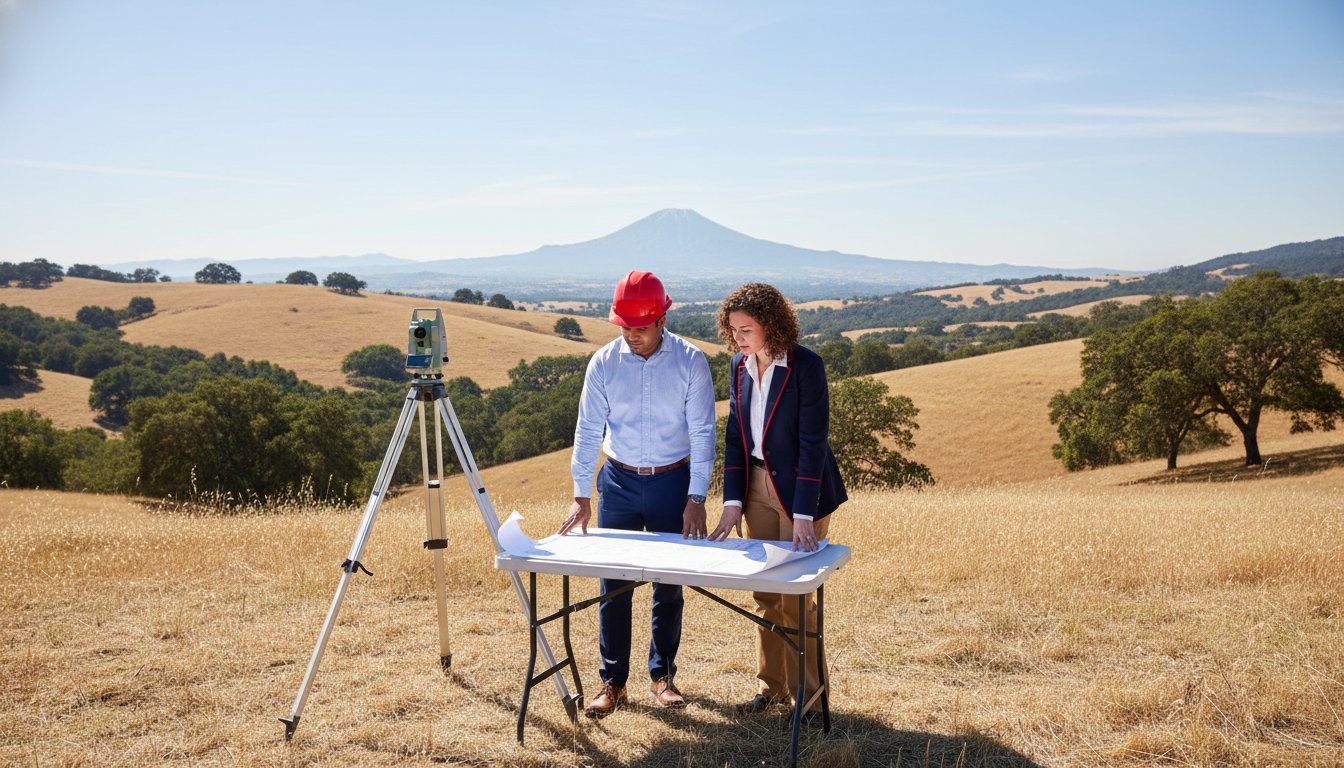
What if the scenic hillside lot you've been eyeing is actually a legal and financial labyrinth that could stall your vision before the first shovel hits the dirt? Successfully evaluating land for new construction in contra costa county requires more than just an aesthetic eye; it demands a technical deep dive into the 2025 California Building Codes and the county's latest fee structures. You likely feel a mix of excitement and legitimate anxiety about complex zoning codes or those notorious utility hookup fees. It's a significant investment, and the fear of purchasing a parcel that isn't actually buildable is a common hurdle for many prospective homeowners.
We've designed this guide to transform that uncertainty into a precise roadmap for success. You'll learn how to navigate the 2026 permit fee schedules and the Contra Costa Water District's latest requirements to ensure your project remains both compliant and cost-effective. We will break down the essential feasibility checklist, from SB 9 density opportunities to the specific infrastructure demands that define a successful build in today's regulatory environment. This structured approach provides the clarity you need to proceed with confidence and realize your vision through disciplined planning.
Key Takeaways
- Master the essential phases of evaluating land for new construction in contra costa county by integrating zoning analysis with physical engineering assessments.
- Distinguish between ministerial and discretionary permits to predict your project timeline and navigate the specific requirements of County Ordinance Code Chapter 96-2.
- Identify the critical role of soil testing in managing expansive ground conditions common to the San Ramon and Walnut Creek corridors.
- Uncover the hidden financial impact of utility hookup fees from providers like EBMUD and the Central Contra Costa Sanitary District before finalizing your land purchase.
- Learn why engaging a custom home builder during the pre-construction phase provides a vital layer of fiscal responsibility and technical oversight.
The Fundamentals of Land Evaluation in Contra Costa County
Evaluating land for new construction in contra costa county is an intricate process that demands a synthesis of legal, engineering, and financial intelligence. We define land evaluation not as a simple walkthrough, but as the critical intersection where zoning laws meet physical constraints and fiscal reality. Unlike neighboring regions with flatter terrain or more lenient development standards, Contra Costa County, California maintains rigorous land-use policies designed to manage its diverse topography and environmental sensitivity. These regulations ensure that every new residence contributes to the safety and longevity of the local community, but they also require a higher level of due diligence from the homeowner.
The Public Works Department acts as a primary gatekeeper for residential new construction. They oversee engineering standards that dictate how your future home interacts with county infrastructure, including drainage, road access, and encroachment permits. Before you fall in love with a view, you must verify the parcel's data. Your first step is to identify the Assessor’s Parcel Number (APN). This unique identifier allows you to access current assessor data, which reveals the property’s recorded history, existing liens, and designated land use. Starting with these facts establishes a foundation of predictability for your entire project.
Why 2026 is a Pivotal Year for Bay Area Land
The East Bay land market has reached a point of high demand and limited supply. In 2026, state-level mandates like Senate Bill 9 and Senate Bill 450 have fundamentally changed the potential of single-family lots, allowing for increased density and urban lot splits. While these laws create opportunity, the primary challenge when evaluating land for new construction in contra costa county is the county’s commitment to preserving its unique ridgelines and open spaces. Early evaluation is the only way to prevent buyer’s remorse in a market where land costs and development fees continue to rise. Understanding these shifts helps you capitalize on new housing laws while respecting local constraints.
The Three Pillars of a Buildability Study
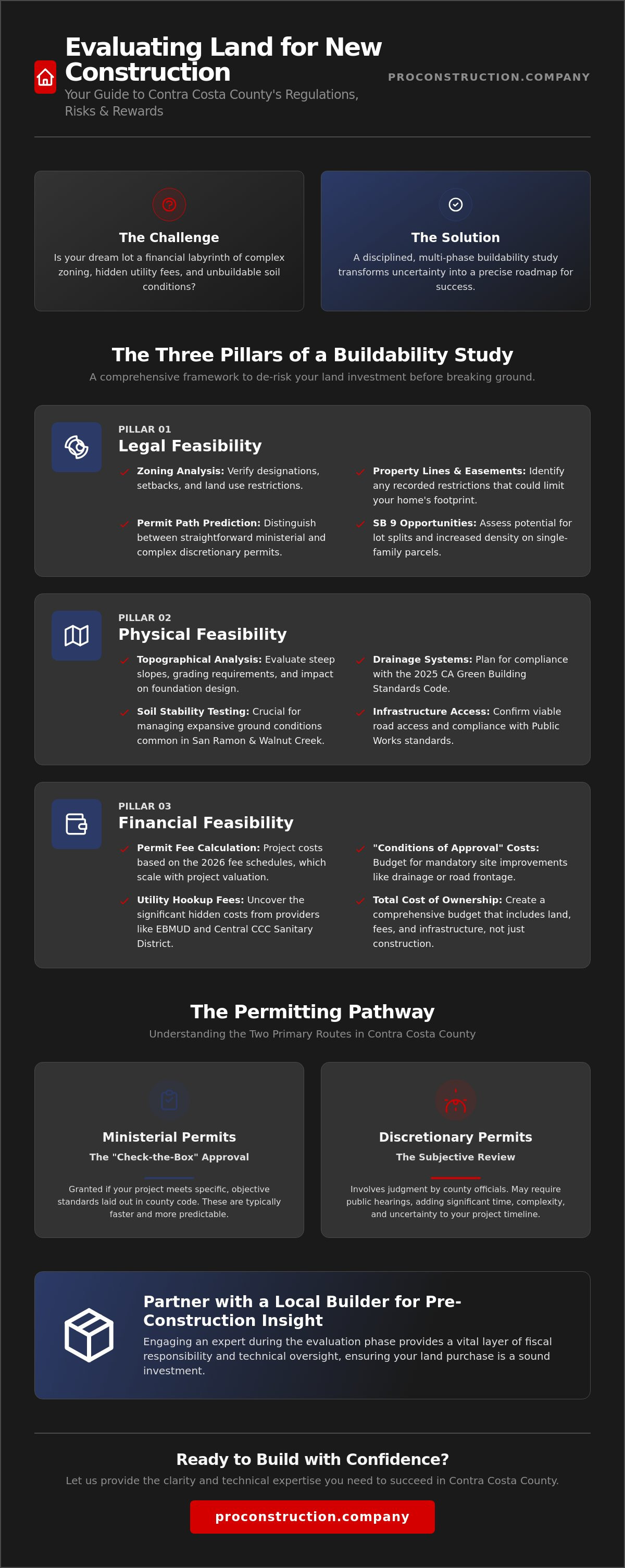
A comprehensive buildability study relies on three distinct pillars to determine a project's success. We break them down into manageable phases to ensure no detail is overlooked:
- Legal Feasibility: We examine zoning designations, building setbacks, and any recorded easements or property line disputes that could restrict the home's footprint.
- Physical Feasibility: This involves analyzing the topography for steep slopes, testing the soil for stability, and planning for complex drainage systems required by the 2025 California Green Building Standards Code.
- Financial Feasibility: We calculate the total cost of ownership by including the 2026 building permit fees, which scale based on project valuation, alongside required infrastructure improvements.
Zoning and Permitting: Navigating County Regulations
Mastering the regulatory framework is a prerequisite for any successful project. In Contra Costa County, the primary roadmap for site development is found within the County Ordinance Code Chapter 96-2. This chapter governs how you improve a parcel, covering everything from grading to private road standards. When evaluating land for new construction in contra costa county, you must first distinguish between ministerial and discretionary permits. Ministerial permits are typically "check-the-box" approvals where the county grants permission if you meet specific, objective standards. Discretionary permits, however, involve subjective judgment by county officials and may require public hearings, adding both time and complexity to your schedule.
A critical, often overlooked element in the permitting phase is the "Conditions of Approval" document. While often associated with large subdivisions, single-family custom builds frequently receive these tailored requirements during the site plan review. These conditions might mandate specific drainage infrastructure or frontage improvements that weren't in your initial budget. We recommend reviewing these documents with a dedicated custom home builder to identify potential cost drivers early in the pre-construction phase. This proactive review ensures that environmental constraints, such as the steep terrain of the Oakland hills or the specific drainage needs of the Central County plains, are addressed before they become liabilities.
Discretionary Permits and Land Use
If your project requires a Land Use Permit or a formal Development Plan, expect a more rigorous review process. In 2026, the timeline for county review typically spans several months, depending on the complexity of the environmental impact. You will also encounter advisory notes from the Engineering Services Division. These notes provide technical guidance on how your build must interact with county-maintained systems. We treat these notes as a blueprint for compliance, ensuring that every technical detail aligns with current standards to avoid costly revisions later.
Setbacks, Easements, and Height Restrictions
Your building envelope is strictly defined by setbacks and easements. Most residential zones in the county require specific distances between your home and the property lines, but utility easements can further restrict where you can legally build. Additionally, if your land sits within a Wildland-Urban Interface (WUI) zone, you must adhere to stringent fire safety requirements. These include non-combustible building materials and defensible space mandates that are essential for protecting your investment in fire-prone regions. Identifying these boundaries early ensures your architectural vision fits perfectly within the legal limits of the lot.
Assessing Physical Constraints: Soil, Slope, and Drainage
Physical constraints are the silent variables that define your project's ultimate viability. While a lot might look perfect on a sunny afternoon, the technical reality of the terrain often dictates the complexity of the build. When evaluating land for new construction in contra costa county, we prioritize a rigorous assessment of the earth itself. Soil testing is arguably the most important $5,000 investment you'll make. In regions like San Ramon and Walnut Creek, expansive soils are common. These clay-heavy soils swell when wet and contract when dry, exerting immense pressure on foundations. Identifying these conditions early allows us to plan for specialized engineering rather than reacting to structural issues after the concrete is poured.
Topography presents another significant layer of complexity, particularly in the East Bay hills. Building on steep grades requires more than just an aesthetic vision; it demands extensive retaining walls, complex grading plans, and often, deep pier-and-grade-beam foundations. These elements significantly increase the site preparation budget compared to the flatter plains of Central County. We also factor in the 2026 Sediment and Erosion Control (SEC) fees, which are calculated at 0.0005 times the permit valuation, with a minimum of $150 for new residential construction. This fiscal detail is a small but necessary part of a disciplined pre-construction plan.
Geotechnical Reports and Foundation Design
A geotechnical engineer provides the data necessary to secure your home to the hillside. They analyze the shear strength, moisture content, and compaction levels of the soil. In Contra Costa County, specific geologic hazard zones require even deeper scrutiny to mitigate landslide risks. The resulting geotechnical report dictates your foundation type. Whether your lot requires a standard spread footing or a complex system of steel-reinforced piers, the soil quality is the primary driver of your foundation price and long-term peace of mind.
Drainage and Infrastructure Requirements
Modern development in the county is governed by the Contra Costa Clean Water Program. This program mandates that your lot must manage its own storm runoff without negatively impacting neighboring properties or the county’s watershed. We focus on these key infrastructure standards:
- Cleanwater Facilities: New builds must often include bio-retention basins or permeable surfaces to filter rainwater.
- Storm Drainage: Public Works standards require robust systems to direct water away from structures and into approved municipal drains.
- Access Roads: If your lot is off a private road, it must meet specific width and weight-bearing standards for emergency vehicle access.
Complying with these "Cleanwater" requirements is a non-negotiable part of the 2025 California Green Building Standards Code. We ensure that every drainage plan is both compliant and efficient, protecting your property from erosion and water damage.
Utility Connectivity and Hidden Development Costs
The "Golden Rule" of site development is simple: if there are no utilities, there is no house. When evaluating land for new construction in contra costa county, the proximity of water, sewer, and power lines is the primary determinant of your project's financial health. Bringing services to a remote lot can cost more than the land itself. We approach these assessments with meticulous detail, ensuring that every connection point is verified before you commit to a purchase. In 2026, utility providers have implemented specific fee adjustments that require careful budgeting to maintain fiscal responsibility.
Securing power through PG&E remains a significant hurdle in the East Bay. The timeline for new electrical service in 2026 often extends several months, requiring proactive management to avoid construction delays. We integrate these utility schedules into our project management flow to ensure a seamless transition from site prep to vertical construction. Beyond the physical lines, you must account for "soft costs." These include the valuation-based building permit fees. For a project valued over $1,000,000, the 2026 fee schedule sets a base of $5,012.25 plus $2.75 for each additional $1,000 of value. Planning for these expenses early prevents the budget surprises that often derail ambitious builds.
Water and Sewer Availability
Your water strategy depends heavily on your provider. The Contra Costa Water District updated its service fees effective April 1, 2026, often requiring a refundable design deposit of $5,000 or more for new single-family residences. If your lot isn't yet within the district, the minimum annexation fee increased to $1,500 in 2026. You must obtain a "Will Serve" letter from your provider to prove they can meet the fire flow requirements for your specific lot. If a public sewer line from the Central Contra Costa Sanitary District is inaccessible, we must evaluate the feasibility of a private septic system, which introduces its own set of county health department regulations.
Calculating County Impact Fees
Development impact fees are designed to mitigate the strain a new home places on local infrastructure. These aren't mere administrative charges; they're significant investments in the community's future. We break these down into three primary categories:
- School District Fees: These developer fees are calculated per square foot and vary by district across the county.
- Transportation Mitigation: Fees that fund road improvements and traffic management near your new build.
- Park and Open Space Fees: Contributions toward the maintenance of county recreational areas.
Managing these complex variables requires a partner who values order and detail. To ensure your budget accounts for every hidden cost, consider partnering with an expert custom home builder who can provide a comprehensive pre-construction analysis.
Partnering with a Local Builder for Pre-Construction
Deciding to purchase a parcel of land is a significant commitment that shouldn't be made in isolation. We believe the most effective way to mitigate risk is to hire a builder before you finalize your purchase contract. While a realtor focuses on market value and location, a premier custom home builder views the property through the lens of technical feasibility and total project cost. When evaluating land for new construction in contra costa county, having an expert eye during a site walk reveals hidden challenges that aren't visible on a parcel map. This proactive partnership ensures that your vision for a new home remains grounded in reality from the very beginning.
Transitioning from the evaluation phase to a fixed-price construction contract requires a builder who understands the nuances of local site preparation. We take pride in our role as a dedicated steward of your investment, providing a level of predictability that's rare in the construction industry. By identifying the specific engineering and utility requirements early, we help you avoid the common pitfalls that lead to budget overruns. Our approach turns the complex process of land assessment into a structured, manageable phase of your larger project.
23 Years of Bay Area Expertise
Experience matters when you're dealing with the specific regulatory environment of the East Bay. We've spent 23 years building relationships with county inspectors and engineers, which allows us to anticipate how they'll interpret the 2025 California Building Code on your specific lot. Our team identifies red flags that professionals outside the building trade often miss, such as subtle signs of unstable soil or non-compliant road widths. In one instance, our early assessment helped a client avoid a $100,000 utility mistake by identifying a misaligned sewer lateral that a previous survey had overlooked. This level of technical oversight is what differentiates a standard service provider from a meticulous construction partner.
Seamless Project Management from Lot to Living Room
Our commitment to high standards extends from the initial site walk to the final flooring installation. We integrate every land constraint, from setback requirements to drainage mandates, directly into your project plan. This holistic approach ensures that your new construction project moves forward with punctuality and fiscal responsibility. We don't just build houses; we manage the entire journey to ensure the final result matches your vision without the typical anxieties of a complex build. If you're ready to take the next step in your journey, contact Pro-Construction for a site evaluation and let us bring our disciplined approach to your future home.
Securing Your Vision Through Disciplined Planning
Building a custom home is a journey that begins long before the foundation is poured. Success depends on the precision of your initial assessment. We've explored the critical intersection of zoning laws, physical terrain, and utility infrastructure. These variables represent the foundation of your investment. Successfully evaluating land for new construction in contra costa county requires a blend of technical expertise and local experience. You now understand the importance of navigating Public Works requirements and the 2026 fee schedules with absolute clarity.
Pro-Construction brings over 23 years of Bay Area construction experience to your project. We maintain an A+ rating for craftsmanship and operational openness; this ensures your build remains predictable and transparent from day one. Our team specializes in navigating the complex standards set by local agencies to protect your capital and your timeline. Start Your Contra Costa Custom Build with a Professional Site Evaluation. Let's transform your vision into a feasible, high-quality reality.
Frequently Asked Questions
How do I check the zoning for a lot in Contra Costa County?
You can identify the zoning designation by visiting the Department of Conservation and Development (DCD) website and using their interactive GIS mapping tool. For parcels in unincorporated areas, the DCD provides the official land-use data; however, if the lot is within city limits, you must contact that specific city's planning department. This step is a vital part of evaluating land for new construction in contra costa county to ensure your project aligns with local density and use requirements.
What is a "Will Serve" letter and why do I need one?
A "Will Serve" letter is a formal document from a utility provider confirming they have the capacity and willingness to provide service to your property. You'll need these from water, sewer, and electrical providers before the county will issue a building permit. It serves as a guarantee that the necessary infrastructure exists to support your new home's requirements.
How much does it cost to get a building permit in Contra Costa?
Permit costs are calculated based on the total construction valuation of your project. For a high-end custom home valued at $1,000,001 or more in 2026, the base fee is $5,012.25 for the first million plus $2.75 for every additional $1,000 of value. You must also include the Sediment and Erosion Control fee, which is 0.0005 times the valuation, alongside various school and transportation impact fees.
Can I build a custom home on a lot with a steep slope?
Yes, but building on a steep grade requires advanced engineering and a higher site preparation budget. You'll likely need a pier-and-grade-beam foundation and extensive retaining walls to meet safety standards. These projects often require discretionary reviews to ensure the design doesn't negatively impact the surrounding topography or drainage patterns.
What are the fire safety requirements for new homes in the East Bay?
New homes must comply with the 2025 California Building Code, which includes specific mandates for properties in Wildland-Urban Interface (WUI) zones. These requirements include using fire-resistant roofing materials, non-combustible siding, and ember-resistant vents. You are also required to maintain defensible space by managing vegetation within 100 feet of all structures.
How long does the land entitlement process take in Contra Costa County?
The timeline varies significantly based on the permit type and project complexity. Ministerial permits, which follow objective standards, move relatively quickly through the system. Discretionary permits that require environmental studies or public hearings can take several months or longer to reach final approval. We recommend factor in these durations during your initial project planning phase.
Is it cheaper to buy land with an existing tear-down house?
Purchasing a lot with an existing structure is often more cost-effective because utility connections and basic infrastructure are already in place. You may also receive credits for certain development impact fees that were paid for the original dwelling. While you'll incur demolition costs, the savings on utility hookup fees, such as the $5,000 water service deposit, can be substantial.
Do I need a separate permit for an ADU on my new lot?
You must obtain a separate permit for an Accessory Dwelling Unit, though the process is more streamlined than it was in previous years. Recent state laws, including Senate Bill 9 and Senate Bill 450, allow for ministerial approval of secondary units in single-family zones. This means if your ADU meets specific size and setback standards, the county's review process is significantly faster and more predictable.