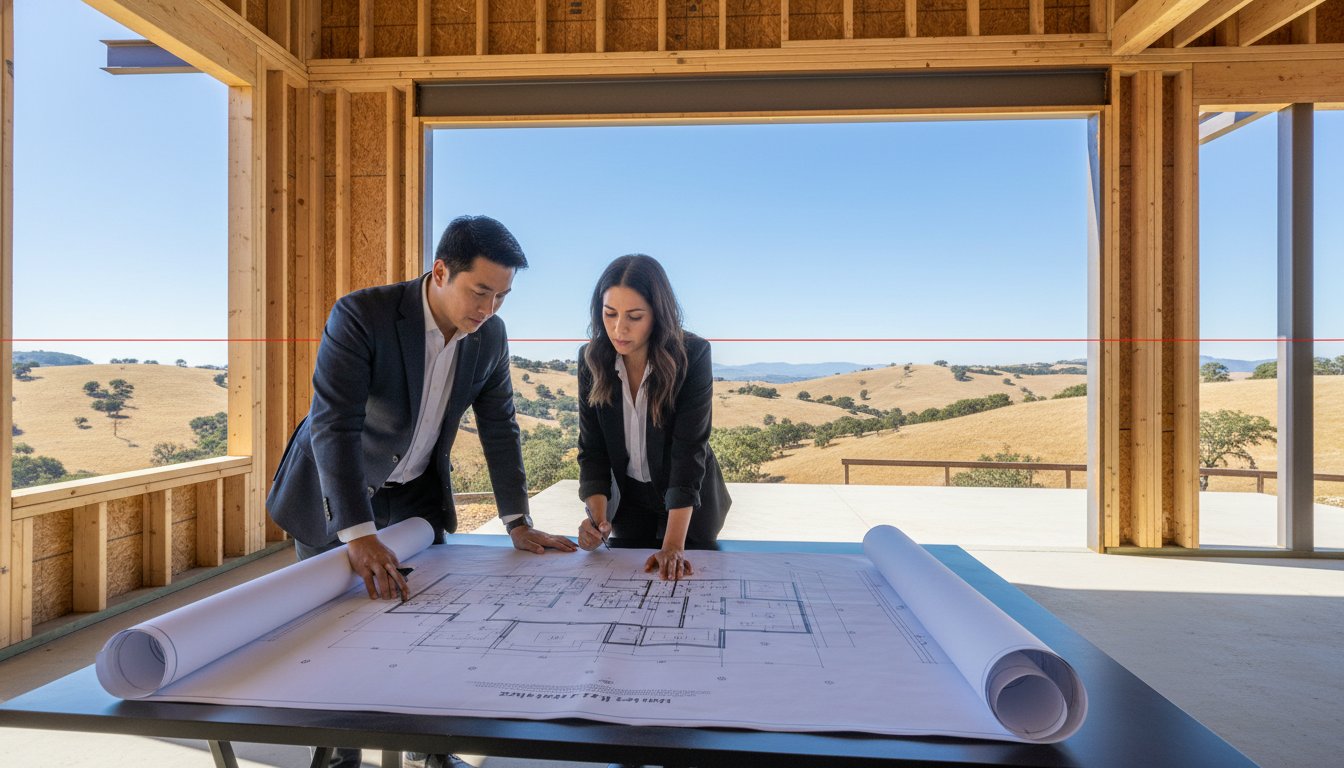
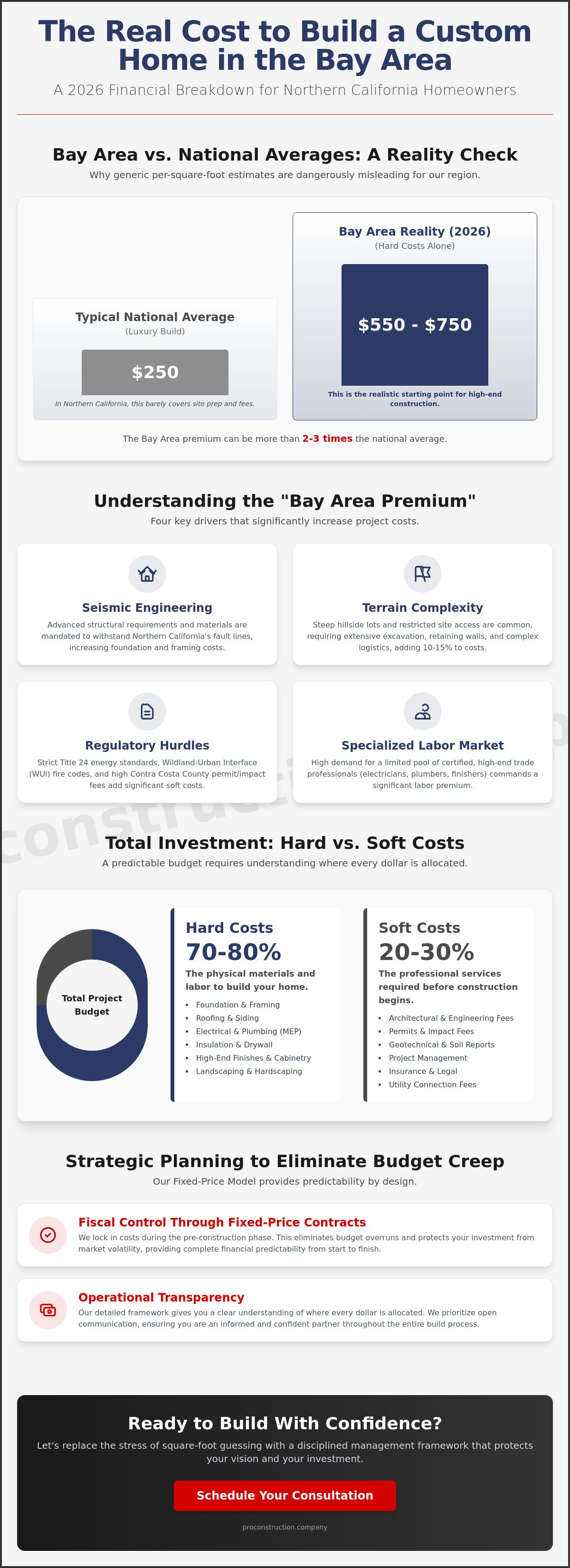
National construction averages suggest you can build a luxury home for $250 per square foot, but in Northern California, that figure barely covers your site preparation and regulatory fees. You've likely felt the frustration of watching unpredictable permit timelines and complex Title 24 energy requirements drive your initial estimates into territory you didn't anticipate. It's a common anxiety for homeowners who value precision but find themselves facing the typical volatility of the Northern California market.
This guide provides a transparent breakdown of the actual cost to build a custom home bay area residents face in 2026. We aim to replace the stress of square-foot guessing with a disciplined, fixed-price management framework that protects your investment. You'll learn how to navigate the 20-35 percent regional cost premium, manage specific Contra Costa County fee structures, and leverage a collaborative partnership to bring your vision to life without fiscal surprises. We'll examine the hard costs of high-end construction and the structured phases that ensure a seamless, professional result.
Key Takeaways
- Learn why national construction averages fail to account for the unique regional premiums and logistical challenges found in Northern California.
- Discover the specific variables that influence the cost to build a custom home bay area residents must navigate, from site preparation to high-end finishes.
- Understand the impact of local regulatory requirements, including Wildland-Urban Interface codes and Contra Costa County permit structures.
- Identify why the pre-construction phase is the most critical period for establishing fiscal control and preventing common budget overruns.
- Explore how a fixed-price contract model provides the transparency and predictability needed to manage a complex new construction project with confidence.
The 2026 Bay Area Custom Home Market: A Reality Check
Building a custom home in 2026 requires a departure from outdated 2024 data. National averages of $150 to $300 per square foot are irrelevant here. In the San Francisco Bay Area, we see a baseline that reflects the ongoing California housing shortage, which continues to drive up land and development expenses. The cost to build a custom home bay area families face is shaped by strict seismic requirements and the latest Title 24 energy standards. These regulations mandate high-performance systems and sustainable materials that increase initial budgets but provide superior long-term efficiency and comfort. We see a clear shift toward luxury builds that prioritize fire-resistant materials and smart-home infrastructure as standard expectations rather than optional upgrades.
Why 2026 is Different for Bay Area Homeowners
Supply chains have finally moved toward a state of predictable stabilization. This allows us to secure material procurement strategies with greater precision than in previous years. We've also observed a significant shift in project scope. Many homeowners now integrate Accessory Dwelling Units (ADUs) into their primary new construction plans to maximize lot utility and property value. However, the labor market remains tight. In the East Bay and Peninsula, the demand for specialized trades continues to outpace the available workforce. This scarcity requires proactive project management to maintain punctuality and high standards. We focus on securing reliable trade partners early to ensure your vision isn't delayed by regional labor shortages.
The "Bay Area Premium": Land, Labor, and Logistics
Logistics often represent the most underestimated portion of a budget. Our region's unique geography, including steep hillside terrain and restricted site access, typically adds 10 to 15 percent to local construction costs. Building in Contra Costa County requires a specific understanding of these physical constraints. Skilled trade labor in areas like Walnut Creek or Lafayette commands a premium due to the high cost of living and the technical expertise required for high-end builds. We define the "Bay Area Premium" as the inescapable combination of high regulatory density and the intense demand for specialized labor. Consider these factors when evaluating your total investment:
- Seismic Engineering: Advanced structural requirements for Northern California fault lines.
- Terrain Complexity: Increased foundation and retaining wall costs for hillside lots.
- Regulatory Fees: Higher impact and development fees compared to national averages.
- Specialized Trades: Premium rates for certified electrical, plumbing, and HVAC technicians.
Understanding these variables is the first step toward a predictable budget. We don't view these costs as obstacles but as necessary components of a structure built to last for generations. Our approach emphasizes operational openness so you understand exactly where your investment is allocated. By acknowledging the reality of the 2026 market early, we establish a foundation of trust and precision for the entire project journey.
Breaking Down the Total Investment: Hard vs. Soft Costs
Achieving a predictable budget requires a clear understanding of where every dollar is allocated. While many homeowners focus on the visible structure, a total project budget is divided between hard costs and soft costs. Generally, hard costs account for approximately 70 to 80 percent of the construction budget. These cover the physical materials and labor used to erect the home. Soft costs make up the remaining 20 to 30 percent, encompassing the professional services and permits required before the first nail is driven. While a national Cost To Build A House might provide a broad baseline, local complexities often shift these ratios significantly. Understanding these categories is essential for anyone calculating the cost to build a custom home bay area residents can actually afford without mid-project surprises.
Hard Costs: Materials and Craftsmanship
Hard costs represent the tangible elements of your new residence. This includes the foundation, framing, roofing, and all mechanical, electrical, and plumbing (MEP) systems. We categorize these as the "bones" of the house. For a mid-range to high-end custom build in 2026, you should budget between $550 and $750 per square foot for hard costs alone. The price variance often stems from your choice of finishes. High-end flooring, custom cabinetry, and integrated smart home technology can quickly move a project into the upper tiers of investment. We believe that the precision of professional flooring and drywall work defines the final luxury feel of a space. These structural and finish elements must be managed with a disciplined eye to maintain the integrity of the design while respecting the budget framework.
Soft Costs: The Price of Permission
Soft costs are the invisible but mandatory expenses that often catch homeowners off guard. These include structural engineering, environmental reviews, and the various impact fees charged by local municipalities. In the Bay Area, these fees can exceed $50,000 before construction even begins. Impact and development fees alone range from $5,000 to over $50,000 depending on the specific jurisdiction and the square footage of the build. If you're building on a hillside in Contra Costa County, you must also account for specialized geotechnical and topographical reports. These documents are non-negotiable for ensuring seismic safety and proper drainage. Plan check fees are another factor, typically costing between 65 percent and 88 percent of the building permit fee itself. We recommend reviewing these requirements early in the pre-construction phase to ensure your new construction project remains fiscally responsible and fully compliant with local law.
Site preparation also falls under this umbrella, including utility hookups and excavation. Connecting to aging Bay Area infrastructure often requires technical upgrades that add to the initial investment. By breaking these costs down early, you transform a complex project into a series of manageable, predictable phases. This structural clarity allows you to move forward with the confidence that your vision is supported by a realistic financial foundation.
Contra Costa County and Local Regulatory Nuances
Understanding the cost to build a custom home bay area residents face requires looking beyond regional averages and into specific municipal requirements. Building in Walnut Creek or Lafayette presents a different set of challenges compared to San Francisco or San Jose. In the East Bay, local building departments place a heavy emphasis on neighborhood character and environmental integration. If you're planning a project in these affluent corridors, you'll likely encounter a rigorous Design Review process. This phase ensures your new construction aligns with local aesthetic standards, which can influence material choices and overall site layout. It's a layer of scrutiny that demands meticulous planning to avoid costly revisions later in the journey.
One of the most significant factors in the East Bay is the Wildland-Urban Interface (WUI) building codes. These regulations apply to homes situated near open spaces or hillsides prone to wildfires. Compliance requires specific fire-resistant materials for siding, roofing, and even specialized attic vents. While these standards increase initial expenses, they're essential for the safety and longevity of your investment. Additionally, you must account for school impact fees. These are calculated based on the total livable square footage and vary significantly between school districts. While the Marin Builders Association 2025 cost estimates provide a helpful baseline for the North Bay, Contra Costa's specific fee structures for parks, drainage, and traffic mitigation create a unique fiscal profile for every lot.
Navigating Local Building Departments
In 2026, the typical timeline for permit approval in Contra Costa County ranges from six to nine months for complex custom builds. This duration depends heavily on the completeness of your initial submission and the responsiveness of local officials. We take a proactive role in managing all communications with city and county departments to keep your project moving forward. Our team understands how to navigate the technical nuances that often stall approvals. For a deeper look at managing these local hurdles, review our Premier Custom Home Builder in Contra Costa County: 2026 Guide.
Zoning and Accessory Dwelling Units (ADUs)
California state laws have significantly streamlined the process for adding an Accessory Dwelling Unit (ADU) to your property. Integrating an ADU during your primary new construction project is often more cost-effective than building one later. Many homeowners now opt for a Junior ADU (JADU), which is contained within the footprint of the main residence. This approach maximizes your lot's utility while providing flexible space for guests or multi-generational living. If you're considering these options, our guide on top ADU contractors explains how these additions impact your total property value and long-term utility.
Strategic Planning to Eliminate Budget Creep
Eliminating budget overruns isn't a matter of luck; it's the result of a disciplined five-step framework. Many homeowners believe that once construction begins, costs are naturally fluid. We challenge this assumption. By shifting the focus to a rigorous pre-construction phase, we ensure the cost to build a custom home bay area families expect remains stable from start to finish. Our process follows a logical progression: feasibility and site analysis, program definition, conceptual design review, detailed specification, and finally, the execution of a fixed-price contract. This structured approach allows us to address potential hurdles before they become expensive field changes.
Value engineering plays a critical role in this journey. This isn't about cutting corners; it's about maximizing the impact of your investment. We analyze every system and material to find high-performance alternatives that don't sacrifice the luxury aesthetic. For example, selecting a specific high-efficiency HVAC system might save thousands in ductwork complexity while meeting Title 24 requirements. We often see that strategic trade-offs between expansive square footage and high-density custom features result in a more refined, livable home. If you're ready to secure a predictable path for your project, our team at Pro-Construction is prepared to lead the way.
The Importance of Detailed Specifications
The most effective way to prevent budget creep is to finalize every selection before breaking ground. Picking your finishes, from flooring to light fixtures, allows us to create a comprehensive Scope of Work. This document acts as the definitive roadmap for the project, leaving no room for ambiguity. Experienced general contractors in the San Francisco Bay Area now utilize advanced project management technology to track these specifications against real-time material costs. This transparency ensures that you're never left wondering where your budget stands as the build progresses.
Managing the Contingency Fund
While we strive for absolute precision, a healthy project still requires a contingency fund. For a new construction project in 2026, we recommend a buffer of 10 to 15 percent. It's vital to distinguish between "known unknowns," such as unexpected soil conditions discovered during excavation, and poor planning. A well-managed project uses the contingency for true emergencies, not for undecided paint colors or late-stage layout changes. Every hour invested in the pre-construction office typically yields ten hours of savings on the construction site. This philosophy of punctuality and fiscal responsibility is what separates a successful build from a stressful one.
Pro-Construction’s Fixed-Price Model: Predictability by Design
Many builders operate on a "Time and Materials" basis, which often leaves the homeowner vulnerable to market fluctuations and sudden labor cost surges. We believe this model is fundamentally flawed for high-stakes projects. Instead, we utilize a Fixed-Price Residential Construction Contract. This model acts as the ultimate antidote to the volatility that often plagues the cost to build a custom home bay area residents initiate. By establishing a firm price before construction begins, we shift the financial risk from your shoulders to ours. This approach demands a high level of precision and detail during the pre-construction phase, but it ensures that your final investment remains exactly what we agreed upon.
Our ability to offer this level of predictability is rooted in over 23 years of local experience. We've built deep relationships with specialized trades across Contra Costa County, allowing us to forecast labor and material requirements with exceptional accuracy. We provide operational openness through every stage of the build. You aren't just a client; you're a collaborative partner in a shared journey. This transparency builds trust and allows us to focus on what matters most: realizing your vision through technical skill and uncompromising standards. We manage the entire process, from the first permit application to the final walkthrough, ensuring a seamless transition into your new residence.
The Benefits of a Single-Contract Approach
A single-contract model provides a clear point of accountability that reduces the inherent stress of a complex build. We manage every detail, including site preparation, structural framing, and the installation of all mechanical systems. This synergy is particularly valuable for property owners who may also be considering essential home renovations on existing structures while their new residence is underway. Our 23-year track record in the East Bay serves as a recurring anchor of reliability. We understand the local soil, the specific municipal permit requirements, and the regional logistical hurdles that others might overlook. This depth of knowledge ensures that your investment is protected by seasoned professional oversight.
Your Journey from Vision to Completion
Your project begins with a thorough consultation and feasibility study. We examine the physical constraints of your lot and align them with your functional goals and lifestyle requirements. This stage is where our commitment to craftsmanship and superior results first takes shape. We guide you through the permitting process, manage the physical execution of the new construction, and conduct a meticulous final walkthrough to ensure every detail meets our high standards. Our goal is to provide a disciplined experience that honors your time and your fiscal responsibility. If you're ready to build with precision and peace of mind, we invite you to schedule a consultation with Pro-Construction today.
Realizing Your Vision with Fiscal Precision
Building a new residence in Northern California requires more than just a dream; it demands a disciplined strategy. We've explored how the cost to build a custom home bay area families invest in is shaped by complex regulatory fees and the necessity of high-performance materials. By prioritizing the pre-construction phase and finalizing every specification before breaking ground, you eliminate the typical anxieties of budget creep. Shifting to a fixed-price contract model provides the transparency you need to protect your investment throughout the construction journey.
Our team leverages over 23 years of specialized expertise in Contra Costa County regulations to ensure your project moves forward with punctuality and precision. We believe that operational openness and technical skill are the foundations of a successful partnership. You deserve a builder who acts as a dedicated steward of your resources while delivering superior results. We invite you to Start Your Predictable Custom Build Journey with Pro-Construction today. Your vision is within reach, and we're ready to help you navigate every phase of the process with confidence.
Frequently Asked Questions
How much does it cost per square foot to build a custom home in the Bay Area in 2026?
Market data for 2026 indicates that the cost to build a custom home bay area residents plan for generally ranges from $450 to $950 per square foot. This wide range accounts for everything from entry-level custom builds to high-end luxury estates. Mid-range hard costs typically fall between $550 and $750 per square foot. Your final investment depends heavily on site complexity and the specific finishes selected during the pre-construction phase.
What are the most expensive parts of building a custom home in Contra Costa County?
Site preparation and regulatory impact fees represent the most significant financial variables in the East Bay. Hillside lots in areas like Lafayette or Walnut Creek often increase base building costs by 15 to 30 percent due to specialized foundation and retaining wall requirements. Additionally, municipal impact and development fees can range from $5,000 to over $50,000 depending on the jurisdiction and total square footage.
How long does the permitting process typically take for a new home in the East Bay?
Expect a timeline of six to nine months for permit approval for a complex custom build in 2026. This duration depends on the specific municipality and the completeness of your initial submission. We manage all communications with city and county departments to ensure the process remains as efficient as possible. Proactive planning during the pre-construction phase is essential for maintaining your project's overall schedule.
Is it cheaper to build a custom home or buy an existing one in 2026?
Buying an existing home often has a lower initial purchase price, but building new offers superior long-term value. A custom build eliminates the immediate need for home renovations and provides the advantage of modern, fire-resistant materials. New construction also ensures full compliance with the latest energy codes, which results in significantly lower utility expenses and maintenance costs over the life of the property.
What is a fixed-price construction contract and how does it protect homeowners?
A fixed-price contract is a legal agreement that establishes a firm total cost before the project begins. This model protects you from the market volatility and labor price surges that often impact the cost to build a custom home bay area residents face. It shifts the financial risk to the builder and requires a highly disciplined pre-construction process to ensure every detail is accounted for before work starts.
Do I need a separate architect and builder, or should I look for a design-build firm?
You can choose to hire these professionals separately or work with a firm that offers a collaborative delivery model. We focus on the construction and management phase, working closely with your chosen design professionals to ensure the project remains fiscally responsible. A unified approach between the builder and the design team is the most effective way to eliminate change orders and maintain budget predictability.
How do Title 24 energy requirements impact my total construction budget?
Title 24 standards mandate high-performance insulation, efficient HVAC systems, and high-quality windows to meet California's strict energy goals. While these requirements increase the initial construction budget, they are a necessary investment in the home's long-term efficiency. We view these regulations as a baseline for quality, ensuring your new residence remains comfortable and cost-effective to operate for decades to come.
Can I build an ADU at the same time as my custom home to save on costs?
Integrating an Accessory Dwelling Unit (ADU) during your primary new construction project is a highly cost-effective strategy. This approach allows you to share mobilization costs, utility trenching, and foundation equipment across both structures. Building simultaneously also streamlines the permitting process and ensures that the aesthetic of the ADU perfectly matches the main residence, maximizing your property's total utility and future resale value.