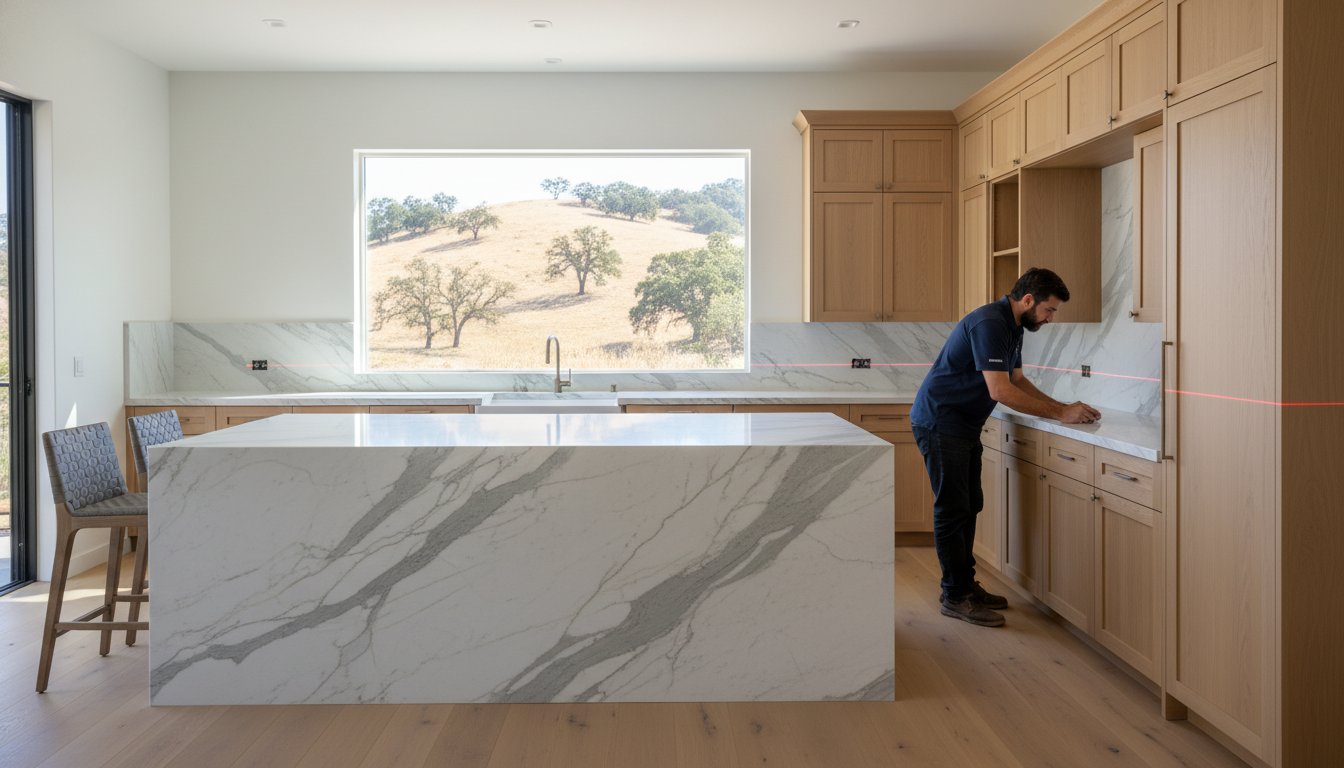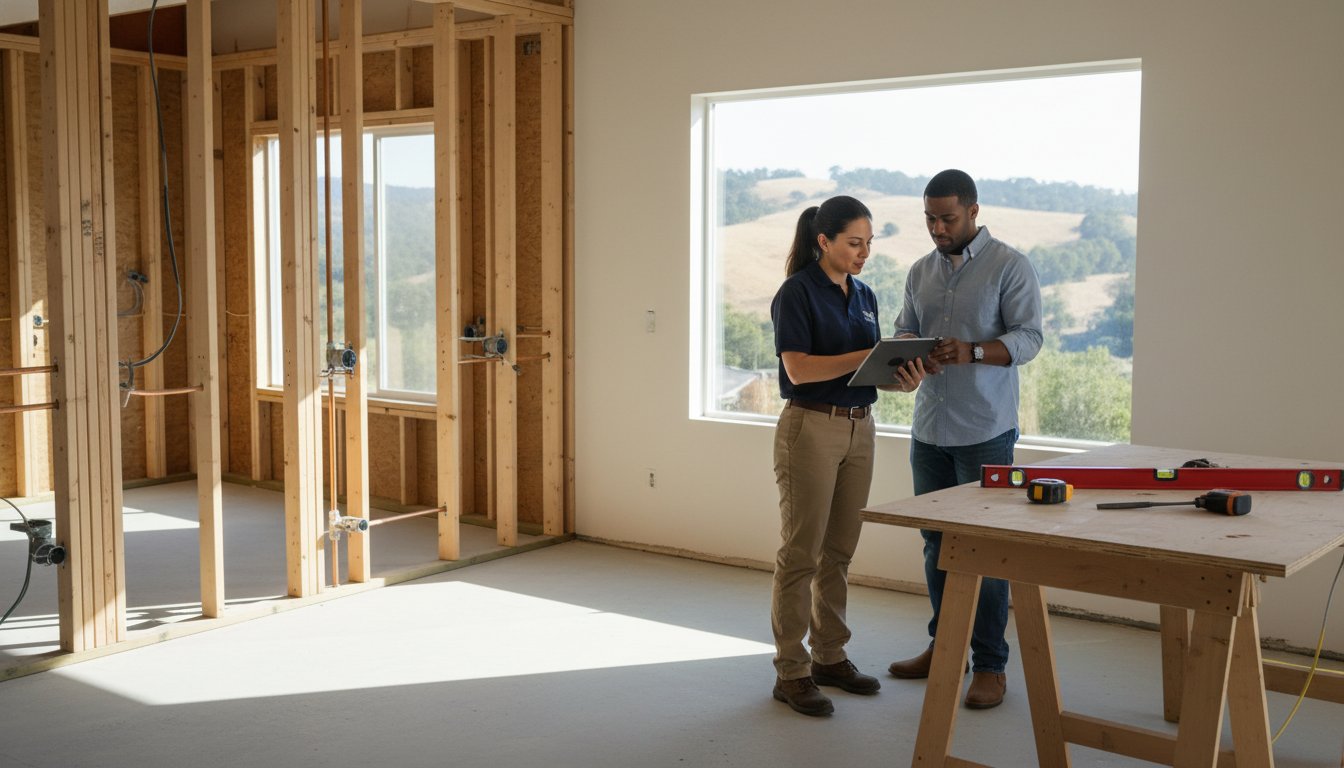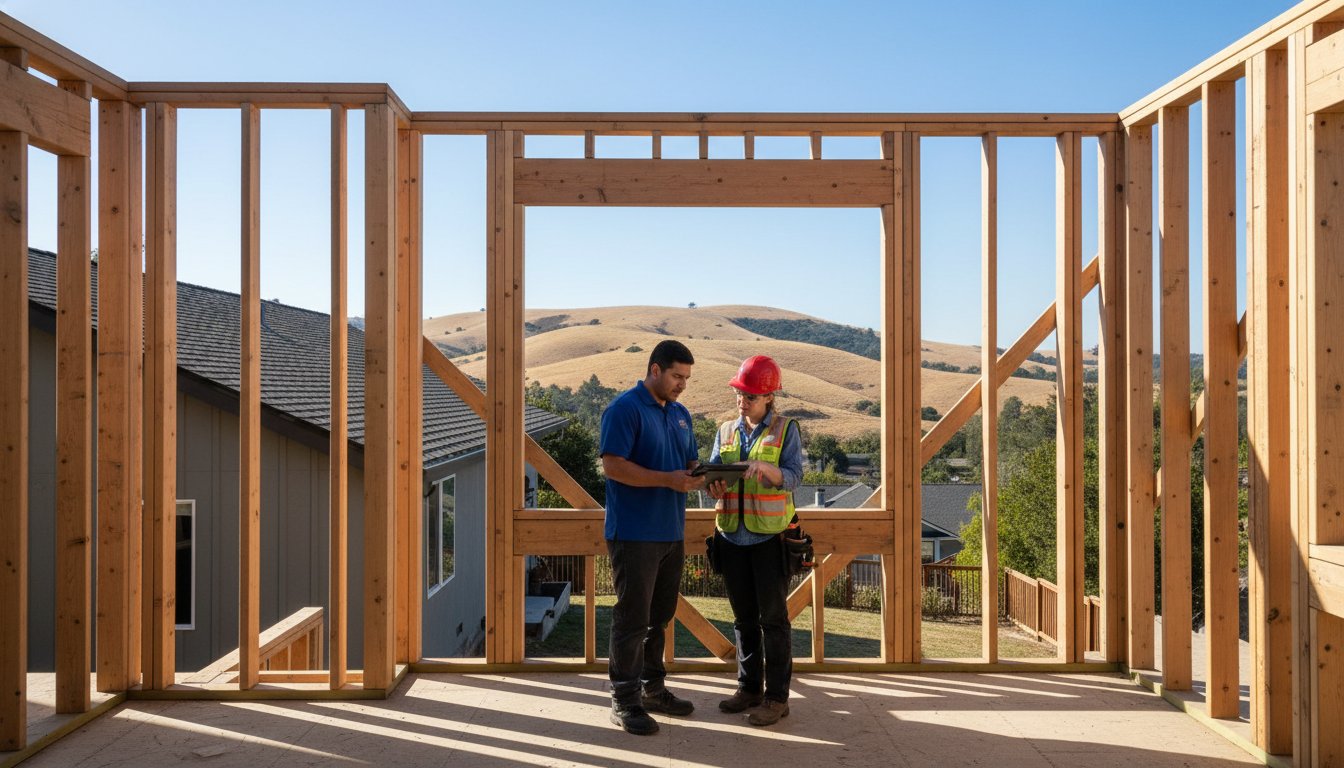
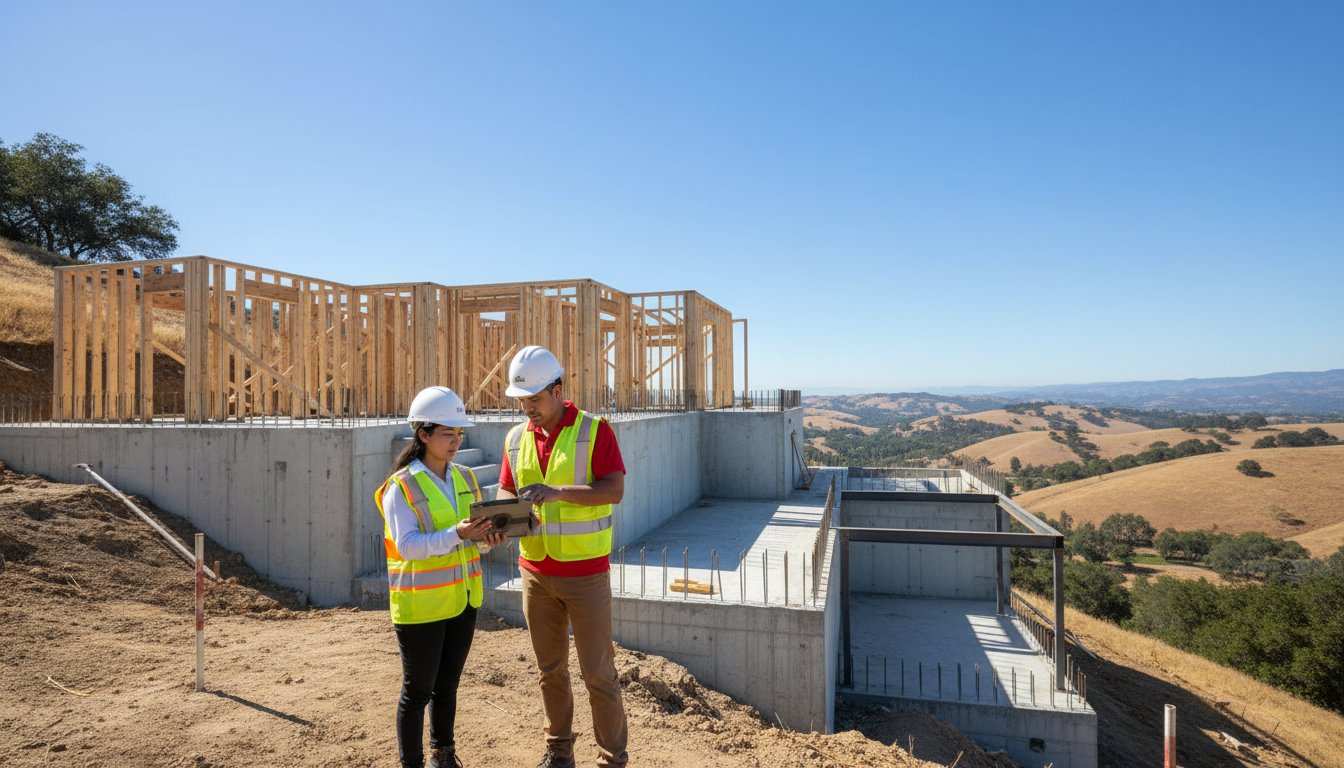
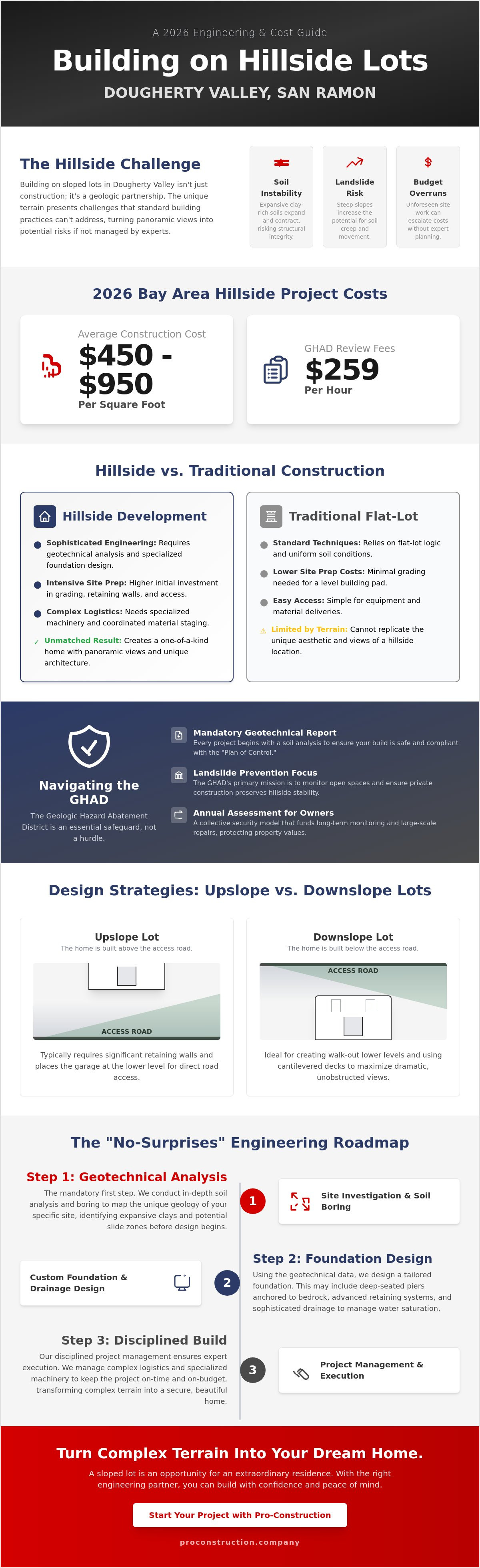
In the hills of San Ramon, your foundation is a geologic partnership where site engineering dictates every architectural possibility. You want the panoramic views that come with a bespoke hillside estate, yet you likely feel the weight of concerns regarding soil instability and the intricate GHAD regulations. Building on a sloped lot in Dougherty Valley requires a meticulous approach to ensure your investment remains secure against the unique terrain of Contra Costa County. We understand that the fear of budget overruns and landslide risks can often overshadow the excitement of a new construction project.
We believe in transparency and a no-surprises philosophy to protect your vision. This guide provides the essential roadmap you need for 2026, from navigating the $259 per hour GHAD review fees to managing the $450 to $950 per square foot average construction costs currently seen in the Bay Area. You'll discover the specific engineering strategies, permitting phases, and design requirements necessary to realize your home with excellence and peace of mind. We'll show you how disciplined project management turns complex terrain into a seamless building experience through integrity and professional oversight.
Key Takeaways
- Master the specialized geotechnical engineering required to stabilize unique hillside soil and protect your structural investment.
- Gain clarity on the Dougherty Valley Geologic Hazard Abatement District (GHAD) to understand your role in local landslide prevention.
- Learn how to optimize your home's layout when building on a sloped lot in Dougherty Valley, whether you are managing an upslope or downslope grade.
- Follow a disciplined engineering roadmap that uses soil analysis and boring to design a "no-surprises" foundation tailored to your site.
- Discover how a transparent partnership with an experienced custom builder ensures your project remains on-time and on-budget despite terrain complexity.
Understanding Hillside Construction in Dougherty Valley
Building on a sloped lot in Dougherty Valley represents a significant departure from standard residential construction. While the rolling hills of San Ramon offer the promise of breathtaking panoramic views, they also present geological challenges that require a sophisticated engineering approach. You cannot apply flat-lot logic to a 20% or 30% grade. We often see homeowners attracted to the lower purchase price of hillside parcels, only to discover that the structural requirements demand a higher investment in ground-up development. Success in this terrain depends on a geologic partnership where site engineering dictates every architectural possibility.
Standard construction techniques are insufficient for the unique hillsides of Contra Costa County. Most suburban builders are accustomed to level pads and uniform soil conditions. In Dougherty Valley, the slope dictates everything from the depth of your piers to the way we stage materials on-site. We prioritize structural integrity above all else, ensuring that your home remains secure against the natural movement of the earth while still capturing the aesthetic value of the high-elevation landscape.
The Unique Topography of San Ramon
The Tri-Valley area is characterized by "expansive" clay-rich soils. These soils expand when wet and contract when dry, which creates a moving target for any heavy structure. When you add a steep slope to this equation, the risk of soil creep or instability increases. Your specific slope gradient determines the complexity of your project. We analyze these percentages to decide if a project requires deep-seated piers or advanced retaining systems. Foundation engineering for these sites is a precise science that ensures your bespoke home is anchored firmly into the bedrock. We also work within San Ramon’s strict height restrictions to preserve natural vistas without violating local building codes.
Hillside Building vs. Traditional Construction
Traditional construction relies on easy equipment access and level staging areas. Hillside projects require specialized machinery capable of operating on inclines and coordinated material deliveries where space is at a premium. Site preparation is often the most intensive phase of the build. As a Premier Custom Home Builder in Contra Costa County: 2026 Guide, we manage these complex logistics to maintain a "no-surprises" timeline. While the initial costs of site work are higher on a slope, the result is a one-of-a-kind residence that traditional lots simply cannot replicate. We focus on transparency throughout this process, ensuring you understand how every dollar invested in your foundation contributes to the long-term excellence of your home.
Navigating the Dougherty Valley Geologic Hazard Abatement District (GHAD)
The Dougherty Valley Geologic Hazard Abatement District (GHAD) is not merely a regulatory hurdle; it's an essential safeguard for your property value. When building on a sloped lot in Dougherty Valley, you're entering a district managed by an independent governmental body dedicated to landslide prevention and slope stability. While the City of San Ramon manages the GHAD, its primary focus is the "Plan of Control." This plan dictates how open spaces are monitored and how private construction must interact with the surrounding terrain. Every project begins with a mandatory geotechnical report. This document is the foundation of your partnership with the city, ensuring your build doesn't compromise the integrity of the hillside.
Property owners within this district pay an annual assessment that funds long-term monitoring and a reserve for large-scale repairs. This collective security model is unique to master-planned communities like ours. It provides peace of mind that the hillsides surrounding your bespoke home are being professionally managed. We view the GHAD as a technical partner. By following their rigorous standards, we ensure your home is an asset that stands the test of time and weather.
Landslide Mitigation and Soil Stability
We prioritize the early identification of "soil creep" and potential slide zones. This proactive stance is vital because the clay-rich soils of the Tri-Valley are prone to movement under heavy saturation. We collaborate closely with geologists to interpret GHAD Engineer’s Reports, translating technical data into actionable building strategies. Adhering to Best Practices in Hillside Construction involves more than just meeting minimum codes. It requires a bespoke approach to drainage and retaining walls that protects both your home and the GHAD-managed open spaces bordering your lot.
The Permitting Process in San Ramon
The permitting phase for hillside homes in San Ramon is exceptionally detailed. You'll encounter specific checklists for Contra Costa County that aren't required for flat-land projects. For instance, the GHAD review process for new construction includes a data collection processing fee of $259 per hour as of the 2025/26 fiscal year. These reviews can extend your project timeline if not managed with precision. We maintain transparency from the start, accounting for these non-routine building permit reviews that often require initial deposits ranging from $500 to $10,000.
By integrating these requirements into our initial planning, we avoid the regulatory hurdles that often stall less experienced builders. Our disciplined approach ensures your vision moves from paper to ground-breaking without unexpected delays. If you're ready to discuss the specific requirements for your site, we invite you to start a partnership with us today. This early coordination is the key to ensuring your home is delivered on-time and on-budget while meeting every rigorous safety standard.
Design Strategies: Upslope vs. Downslope Homes
The direction of the grade dictates every design decision when building on a sloped lot in Dougherty Valley. We categorize these sites into two primary types: upslope and downslope. Each requires a distinct structural philosophy to balance aesthetic value with engineering necessity. For upslope lots, where the land rises from the street, we often design homes that sit "into" the hill. This typically involves a daylight basement that serves as a transition between the street-level garage and the upper living areas. Conversely, downslope lots fall away from the road, providing a natural platform for dramatic views. On these sites, we utilize "stilt" or "pier" construction to project the home over the valley, creating a floating effect that maximizes the site's panoramic potential.
We favor a "stepped foundation" approach for both site types. By following the natural grade in a series of concrete steps, we minimize the need for massive excavation. This preserves the integrity of the hillside and reduces the environmental impact of the build. It also allows for the seamless integration of outdoor living spaces. Large cantilevered decks and multi-level terraces work with the slope rather than fighting it, extending your living area into the surrounding landscape. Our goal is to ensure the home feels like an organic extension of the San Ramon terrain.
Optimizing the Floor Plan for the Grade
Placing entryways and garages effectively is a primary challenge when building on a sloped lot in Dougherty Valley. We often position the garage at the most accessible point to avoid steep, dangerous driveways. If you're planning for future flexibility, consider how these spaces might evolve; our guide on How to Change Your Garage to Living Space in Contra Costa County offers insights into hillside ADU possibilities. We also focus on natural light. By using strategically placed light wells and oversized glazing, we ensure that lower levels, even those partially subterranean, feel bright and inviting.
Retaining Walls and Landscape Architecture
Retaining walls serve a dual role as structural anchors and aesthetic features. For Bay Area seismic standards, we typically recommend reinforced poured-in-place concrete over interlocking blocks. This provides the lateral strength required to hold back tons of earth during a seismic event. These walls allow us to create terraced gardens and flat play areas, turning a steep incline into usable, bespoke outdoor space. Our disciplined approach to site planning ensures that your landscape architecture is as robust and well-engineered as the home itself.
The Engineering Roadmap: Foundation and Drainage
Engineering is the silent partner in every successful hillside project. When building on a sloped lot in Dougherty Valley, the structural design must account for the immense lateral pressure of the earth and the specific seismic activity of the San Francisco Bay Area. We follow a disciplined, five-step roadmap to ensure your home is anchored with absolute integrity. This process begins with geotechnical boring. We drill deep into the soil to analyze the load-bearing capacity of the underlying strata. This data allows us to design a "no-surprises" foundation that accounts for the expansive clay soils typical of San Ramon. Once the soil profile is clear, we move through precise phases of foundation construction, drainage implementation, and erosion control, culminating in final GHAD compliance certification.
Our proactive role in project management means we don't leave site stability to chance. We coordinate with geotechnical engineers to ensure every pier and grade beam meets the highest standards of craftsmanship. This structured approach reflects our commitment to transparency and excellence, providing you with a home that is as secure as it is beautiful.
Foundation Types for Hillside Stability
Deep pier and beam foundations are the gold standard for hillside stability in our region. We often utilize drilled caissons that reach past the unstable clay layer to anchor directly into the bedrock. This method provides superior seismic resistance, which is a critical consideration for any custom build in the Bay Area. While the "cut and fill" method is sometimes used to create level pads, it carries higher risks of settlement in Dougherty Valley. We prefer pier-supported structures because they minimize soil disturbance and maintain the natural integrity of the slope. This bespoke engineering ensures your foundation remains a permanent, immovable asset.
Advanced Drainage and Runoff Management
Water is the primary enemy of hillside construction. If runoff isn't managed with precision, it can lead to soil saturation and eventual slope failure. We implement multi-tier drainage systems that include French drains, swales, and catch basins to divert water away from the structural footprint. It's essential to connect these private drainage systems to the San Ramon municipal storm system correctly to avoid regulatory penalties and protect the surrounding open spaces. Our team manages these connections with meticulous attention to detail, ensuring your site remains dry and stable year-round.
Protecting your investment starts with a foundation built on expert data and disciplined execution. If you are ready to begin your project with a partner who values precision, contact our new construction team to discuss your site's specific engineering needs.
Building Your Vision with Pro-Construction
We bring over 23 years of experience to every project we undertake in the San Francisco Bay Area. Building on a sloped lot in Dougherty Valley requires more than just technical skill; it demands a steward who understands the local terrain. Our "no-surprises" philosophy ensures you receive detailed cost-forecasting for hillside engineering before the first shovel hits the ground. We eliminate the typical anxieties of custom construction through transparency and disciplined project management. Our team takes a proactive role in every phase, ensuring that the high standards we set for ourselves are met at every turn.
We treat every project as a collaborative journey. This partnership begins with the initial topographic survey and continues through the final walkthrough of your bespoke home. Our end-to-end management simplifies the complex GHAD and permitting maze, allowing you to focus on the realization of your vision. We handle the technical coordination between geologists, engineers, and city officials so the process remains seamless for you. We don't just build houses; we manage your investment with the meticulous attention to detail it deserves.
Craftsmanship Meets Engineering Excellence
Bespoke hillside homes require a builder who values precision above all else. We pride ourselves on delivering high-quality results on the most challenging lots in San Ramon. Our commitment to integrity means we never cut corners on structural requirements, especially when managing the clay-rich soils mentioned in previous sections. We believe that true excellence is found in the details that aren't always visible, such as the reinforcement within your pier foundations. For more insights on selecting the right partner for your project, see our guide on 2026 Trends: Choosing General Contractors in San Francisco Bay Area.
Start Your Dougherty Valley Project Today
We recommend an early consultation even before you finalize the purchase of a sloped lot. This allows us to provide a preliminary assessment of the site's potential and the specific engineering requirements it will demand. We offer transparency through fixed-price residential contracts, ensuring your project stays on-time and on-budget. Our goal is to provide peace of mind through every stage of the build. Contact us today to discuss your hillside custom home or ADU project and experience the Pro-Construction standard of excellence firsthand.
Secure Your Investment in the San Ramon Hills
Success in hillside development depends on a disciplined approach to geological reality. You've seen how mastering GHAD regulations and advanced foundation engineering transforms a challenging site into a stable, bespoke residence. Building on a sloped lot in Dougherty Valley is a complex undertaking; however, it's one that yields unparalleled aesthetic rewards when managed with precision and professional oversight. We provide the technical expertise needed to navigate every regulatory phase with a "no-surprises" philosophy that protects your vision.
Our team leverages 23+ years of Bay Area expertise and deep knowledge of GHAD-regulated zones to ensure your project remains on-time and on-budget. From the first soil boring to the final walkthrough, we act as the dedicated steward of your vision through end-to-end project management and transparent communication. We invite you to partner with Pro-Construction for your hillside custom home build to begin your journey toward a seamless and secure property. Your dream of a sophisticated hillside estate is within reach when built on a foundation of integrity and excellence.
Frequently Asked Questions
Is it safe to build on a sloped lot in Dougherty Valley given the landslide history?
Yes, it's safe to build on these hillsides because modern engineering standards and GHAD monitoring mitigate the risks of soil movement. We utilize deep-seated piers and advanced drainage to ensure your home remains stationary regardless of the terrain's history. These rigorous standards mean that new construction on a sloped lot in Dougherty Valley is often more secure than older properties built before current seismic and geotechnical codes.
How much more does it cost to build on a slope compared to a flat lot in San Ramon?
Hillside builds carry a premium for site preparation and structural complexity. You should expect higher costs for excavation, retaining walls, and specialized foundation systems like caissons. While the land purchase price might be lower, the investment in engineering ensures the home's long-term integrity and captures the value of the panoramic views. We provide detailed cost-forecasting to ensure you understand these variables before the project begins.
What is the GHAD assessment, and how does it affect my building permit?
The GHAD assessment is a property tax addition that funds the monitoring and maintenance of hillsides and drainage systems. During the permitting phase, the GHAD must review your plans to ensure they don't negatively impact the regional "Plan of Control." We manage this coordination to ensure your building permit meets all district requirements for slope stability and geologic safety. This oversight protects your property value and the surrounding community.
Do I need a special architect for a hillside home in Contra Costa County?
You should partner with an architect who has a proven portfolio of hillside projects in Contra Costa County. Hillside design requires a deep understanding of grade changes, daylighting, and structural integration. We work closely with your chosen design professional and structural engineers to ensure the architectural vision is technically feasible and meets all local building codes for sloped terrain. This collaboration is essential for a seamless build.
How long does the permitting process take for a sloped lot in San Ramon?
Permitting for a sloped lot generally takes between six and twelve months in San Ramon. This timeline accounts for the standard city building department review plus the specialized GHAD and geotechnical approvals. We proactively manage these submissions to prevent unnecessary delays and keep your project moving through the regulatory maze with precision and transparency. Our disciplined approach helps maintain your construction schedule.
Can I build an ADU on a sloped lot in the Bay Area?
You can certainly build an Accessory Dwelling Unit (ADU) on a sloped lot. We often utilize daylight basements or space beneath the main residence to create high-end, functional units without increasing the home's footprint. Building on a sloped lot in Dougherty Valley provides unique opportunities for ADUs with private entrances and separate outdoor terraces that flat lots cannot accommodate. It's a bespoke way to maximize your property's utility.
What kind of foundation is best for the clay soils in Dougherty Valley?
Drilled concrete piers are the most effective foundation type for the expansive clay soils found in this region. These piers extend deep into the earth to reach stable bedrock or dense soil layers that don't shift with moisture changes. This method prevents the "heaving" or settling that can damage homes built on standard slab foundations in the Tri-Valley area. We prioritize this structural integrity to ensure your home remains an immovable asset.
How do I manage backyard drainage on a steep hill?
Manage steep backyard drainage by implementing a tiered system of swales and French drains. These features collect surface runoff and subsurface water, directing it safely away from your foundation and into the municipal storm system. We design these systems to be both functional and aesthetic, often incorporating them into the landscape architecture as dry creek beds or terraced gardens. Proper drainage is your best defense against soil instability.